
TRT in Australia 2025: Cost, PBS vs Private & What to Expect
TRT in Australia: Cost, Process, PBS vs Private
You've read about TRT, and you've watched the videos. You're fairly convinced low testosterone might be part of what's going on with your energy, your body, your mood. Now you want to know the practical reality: how do you actually get it in Australia, what will it cost, and what's the catch?
This is the guide that answers all of it plainly, honestly, without the marketing spin.
First: What TRT Actually Is (and Isn't)
Testosterone Replacement Therapy (TRT) is a medically supervised treatment that restores testosterone to optimal physiological levels in men with confirmed deficiency. In Australia, it is classified as a Schedule 4 prescription-only medication under the Therapeutic Goods Administration (TGA). It is completely legal, but only when prescribed by a registered Australian doctor.
TRT is not a performance-enhancing drug. It is a hormonal correction for a clinical deficiency, the same way thyroid medication corrects an underactive thyroid. The goal is to restore, not to elevate beyond physiological range.
TRT is available in three main forms in Australia:Injections (most common) — testosterone cypionate or enanthate, typically self-administered intramuscularly every 1–2 weeks. Most cost-effective and clinically effective.
Topical gels and creams — applied daily to skin. More consistent hormone levels but require caution around skin transfer to partners or children.
Patches — less commonly prescribed. Similar mechanism to gels, higher cost.
Compounded testosterone creams (custom-formulated by compounding pharmacies) are also available privately and are popular for their flexibility in dosing.
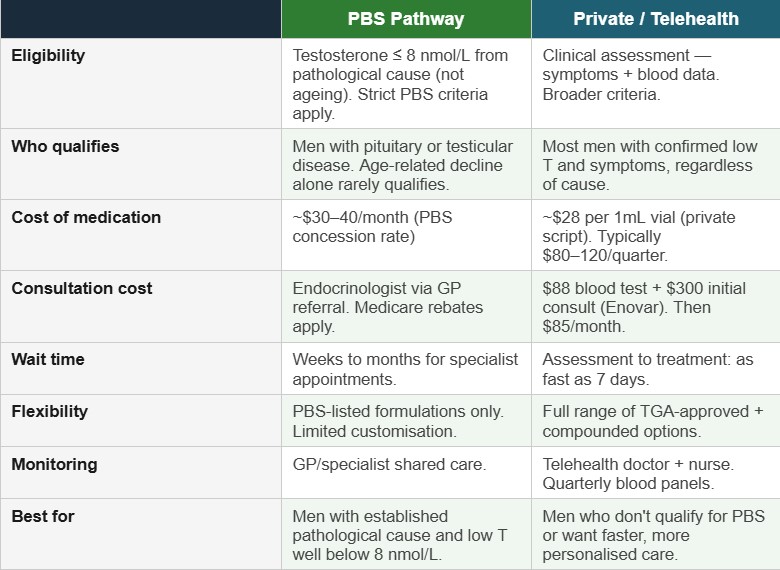
The Two Pathways: PBS vs Private — Honest Comparison
What No One Tells You About the PBS
The PBS threshold is the part of this conversation that frustrates most men and clinicians.
In practice, PBS subsidy for TRT requires testosterone levels at or below 6 nmol/L for the strict authority pathway. That is well below the clinical definition of hypogonadism used by most international guidelines, which set the threshold at 8–12 nmol/L. For men over 40 without a clearly identified pathological cause (testicular disease, pituitary failure), age-related testosterone decline alone doesn't qualify.
What this means in practice:
A man with testosterone of 7 nmol/L shows significant symptoms, low free testosterone, and elevated SHBG. He may have every clinical marker of deficiency and still be told he doesn't qualify for subsidised treatment.
This is the gap the private telehealth model was built to fill.
PBS is a publicly funded scheme that must manage resource allocation across the entire population. But it means that many men with unique clinical needs are effectively excluded from affordable treatment unless they pursue the private pathway.
The Real Cost of TRT in Australia — 2025 Numbers
Here's an honest breakdown of what Australian men are paying across different pathways:
PBS pathway (if you qualify):
Blood tests: Medicare-covered (bulk-billed in most cases)
Endocrinologist: ~$100–150 out-of-pocket after Medicare rebate
Medication: ~$30–40/month (PBS subsidised)
Annual estimate: ~$500–800 all-in (for eligible patients)
Private telehealth — market average:
Blood test: $88–120
Initial doctor consultation: $200–300
Ongoing subscription: $100–220/month
Medication: ~$80–120/quarter
Annual estimate: $1,600–2,600
Enovar's pricing (transparent, no hidden fees):
Blood test: $88
Initial doctor consultation: $300
Monthly subscription: $85/month (includes consultations, nurse access, monitoring)
Medication: ~$80–120/quarter (separate, clearly outlined upfront)
Annual estimate: ~$1,400–1,700 — significantly below the market average
What the Monitoring Actually Looks Like
One of the most important yet under-discussed aspects of TRT is what happens after the first script. This is where many clinics fall short.
Properly supervised TRT requires monitoring of:
Testosterone levels (total and free) — This is to confirm that T levels are in the therapeutic range. If T levels are too low, the protocol isn't working, while too high levels involve risks.
Hematocrit (red blood cell concentration) — TRT can increase red blood cell production. If hematocrit rises too high, it increases cardiovascular risk. This is monitored and managed with protocol adjustments.
PSA (prostate-specific antigen) — prostate health marker. Checked before starting TRT and monitored regularly thereafter in men over 40.
Oestradiol — Testosterone converts to oestrogen. Maintaining balance is important. Excess oestradiol causes symptoms including water retention, mood changes, and reduced libido.
General cardiovascular and metabolic markers — Monitoring of blood pressure, lipid profile, and fasting glucose are part of a responsible treatment protocol.
At Enovar, every patient on TRT has a blood panel every 3 months reviewed by your AHPRA-registered doctor, with protocol adjustments made as needed. This is not optional, but a clinical standard, and it's included in your $85/month membership.
Three Things Most Clinics Don't Tell You Upfront
TRT suppresses natural testosterone production — Once you start TRT, your body reduces its own testosterone output. This is expected and manageable but it means stopping TRT requires a planned, medically supervised process. It is imperative that you understand this before you start.
TRT affects fertility — TRT suppresses sperm production. If you want to father children in the near future, discuss this with your doctor before starting. There are alternative treatments that support testosterone while preserving fertility.
The first 3 months are adjustment, not destination — Many men expect to feel dramatically different within weeks. The full benefits of an optimised protocol include improved body composition, sustained energy, and mood stability which typically takes 3 to 6 months to fully develop. Hence, patience and consistent monitoring matter.
Is TRT Right for You?
The only way to know is a comprehensive blood test. Not a standard GP panel, a full hormone assessment that includes total testosterone, free testosterone, SHBG, LH, FSH, oestradiol, cortisol, DHEA-S, and thyroid markers.
Testosterone replacement therapy may not be appropriate for every man. Blood testing and targeted science-backed supplementation all play meaningful roles for your overall hormonal health. The right protocol for you depends on what your blood results actually show.
Ready to Find Out Where You Stand
You've done the research, and you know what you're looking for. Now the only question is who you trust to get it right. Enovar's process is straightforward, transparent, and built around your actual biology, not a one-size-fits-all script. Start with a free 3-minute quiz and get a clear picture of where your hormones stand.
No referral required. No waiting list. No hidden costs. Just a clinical protocol built around your blood results, delivered to your door. Stop reading about feeling better. Start choosing the best path forward to live fully, not just get by.
MEDICAL DISCLAIMER: This article is for informational purposes only and does not constitute medical advice. TRT requires a prescription from an AHPRA-registered Australian doctor. Costs and PBS criteria referenced are current as of May 2026 and are subject to change. Always verify current pricing and eligibility with your healthcare provider.